


Beyond the Bowl: Part 1 — The training secret in the bowl.
We are pairing with Dr. Pepe Hernandez for a new series called
Beyond the Bowl.
Pepe is a behaviorist with a Ph.D. in Behavioral Neuroscience. Through his work at PJH Dog Training, he focuses on the science of how dogs learn and react. He understands the neurology behind behavior and how the brain handles stress.
A raw diet does more than fill a belly. It fuels the brain.
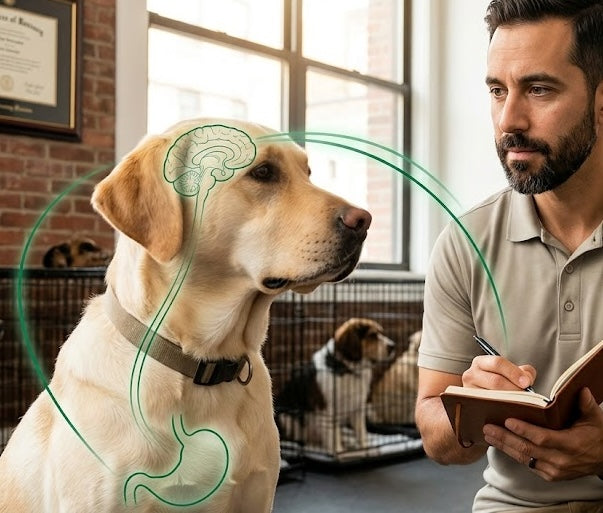
In this first post, we are looking at the gut-brain connection. A dog’s digestive system and their brain are constantly talking to each other. When a dog eats processed fillers, it can lead to inflammation. This inflammation often shows up as "brain fog" or high anxiety.
Raw, species-appropriate food supports a healthy gut microbiome. A healthy gut leads to a calmer, more focused dog. This is why nutrition is the first step in any training program.
We want to give you the insights to help your dog thrive both physically and emotionally. Watch for our next update where we look at how food impacts energy levels.

Before We Blame the Dog, We Should Look at the Bowl
By Dr. Pepe Hernandez, PhD, CPDT-KA
In my work as a behavioral neuroscientist and certified professional dog trainer, I see the same pattern unfold in living rooms across New York City every week. An exhausted dog owner sits across from me. They have taken the classes, watched the videos, read the books, and practiced the exercises. Yet their dog still cannot focus for more than thirty seconds. They still explode into chaos at the front door. They still cannot settle after a walk.
Before I ask about training history, cues taught, reinforcement schedules, or behavior plans, I ask one deceptively simple question: What are you feeding?
The answer can clarify patterns that training alone has not resolved.
It’s Biology, Not a Trend
The connection between what a dog eats and how a dog behaves is not a lifestyle trend. It is biology. The brain that shows up to every training session, every walk, and every moment of stress or excitement is built, maintained, and regulated by the nutrients in your dog’s bowl. When those nutrients are incomplete, degraded, poorly balanced, or poorly tolerated, the nervous system may reflect it. Training can still help, of course, but repetition and positive reinforcement work best when the dog has the nutritional support needed to regulate, recover, and learn.
“The best training investment you will ever make is not always a new technique or a better treat pouch. It is the quality of the food in your dog’s bowl — every single day.”
This article is about what I have observed in over a decade of working with dogs, what nutrition and neuroscience research increasingly supports, and what Artisan Raw has understood from the beginning: the food in a dog’s bowl helps build the brain that training depends on.
Building the Foundation.
Nutrition does not replace training, and no diet can override genetics, pain, fear history, stress, poor sleep, or the learning environment. But the canine nervous system is nutritionally dependent. Research in dogs has linked specific dietary factors — including
- DHA, omega-3 fatty acids,
- Antioxidants,
- B vitamins,
- Mitochondrial cofactors, medium-chain triglycerides, and
- Essential vitamins such as thiamine.
With brain development, cognitive function, learning measures, memory, and age-related cognitive resilience [1–5]. In puppies, DHA-rich diets have been associated with better performance on several learning-related tasks [2]. In older dogs, enriched diets and targeted nutrients have been studied for their ability to support cognitive function, spatial learning, memory, and attention [3,4,6,7]. Severe nutrient deficiencies can also produce neurological abnormalities, reminding us that nutrition is not cosmetic; it is foundational biology [1,5].
That is the real connection between the bowl and the behavior plan. A complete, carefully balanced, whole-food diet may support more than a dog’s body condition, coat quality, or digestion. It may also help support the brain systems involved in focus, emotional regulation, recovery, and learning. When that biological foundation is paired with consistent, positive reinforcement training, we give dogs a better chance to show up ready to learn — not magically transformed, not instantly obedient, but better supported from the inside out.
“The bowl does not train the dog. But it helps build the brain that training depends on.”
— Dr. Pepe Hernandez, PhD, CPDT-KA