

Beyond the Bowl: Part 2 — How Gut Comfort Helps a Dog Focus
We are back with the second part of our series
Beyond the Bowl.
with Dr. Pepe Hernandez. As a behavioral neuroscientist, and owner of PJH Dog Training, Pepe looks at the "why" behind a dog's inability to pay attention.
Last week, we learned that the bowl builds the brain. This week, we are looking at the connection between your dog’s gut and their ability to learn.
The Neuroscience of a Trainable Dog: What Is Happening in the Brain
By Dr. Pepe Hernandez, PhD, CPDT-KA
Training is not just repetition. At a neurological level, every successful training moment requires a chain of events: the dog notices a cue or environmental signal, allocates attention, regulates arousal, performs a behavior, processes feedback, and stores information for the future.
That chain depends on the brain’s chemical communication systems. Neurotransmitters do not make training happen by themselves, and behavior can never be reduced to one molecule. But they help explain why nutrition matters: the brain systems involved in focus, motivation, impulse control, stress recovery, and memory all require raw materials from the diet.
Several neurotransmitter systems are especially relevant to trainability. Four are worth highlighting. This week we will start with the first two here.

Serotonin — Regulation, Impulse Control, and Recovery
Serotonin is involved in emotional regulation, impulse control, behavioral inhibition, and recovery from arousal. When serotonin signaling is disrupted, dogs may have more difficulty settling, disengaging from triggers, or recovering after stimulation, although those behaviors can have many causes.
Diet matters because serotonin is synthesized from tryptophan, an essential amino acid that must come from food. A 2000 study in the Journal of the American Veterinary Medical Association found that dietary protein level and tryptophan supplementation influenced some aggression-related behavior scores in dogs, particularly dominance aggression, while effects varied by behavior category. The takeaway is not that tryptophan is a magic behavior supplement. It is that diet can influence biochemical systems involved in behavior.
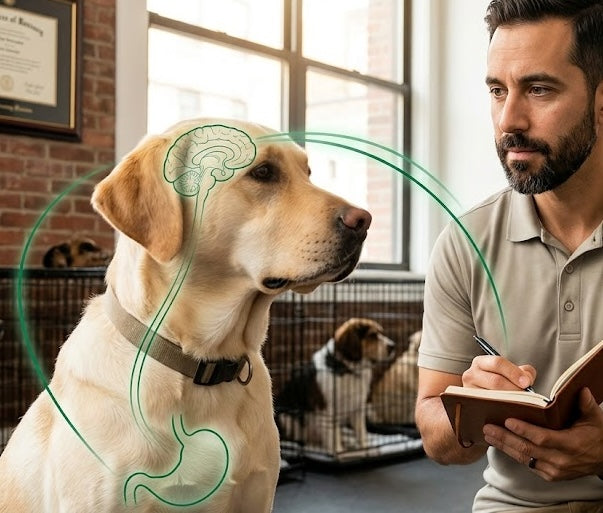
There is also an important gut-brain connection. Most of the body’s serotonin is produced in the gastrointestinal tract, where it helps regulate gut motility, secretion, sensitivity, and inflammation. That does not mean gut serotonin simply becomes brain serotonin.
"It means the digestive system and nervous system communicate constantly through immune, hormonal, microbial, and neural pathways."
— Dr. Pepe Hernandez, PhD, CPDT-KA
Tune in Next Week: Part 3 — Managing Energy Spikes ⚡
Next week, we go even deeper into the brain’s chemistry. We’ll be discussing Dopamine and Noradrenaline—the chemicals responsible for motivation, alertness, and stress.
If your dog struggles with being "over-aroused," has intense "zoomies," or seems frantic after a meal, you won’t want to miss this. Pepe will explain how high-starch diets can lead to "chemical spikes" that make it impossible for a dog to stay calm.